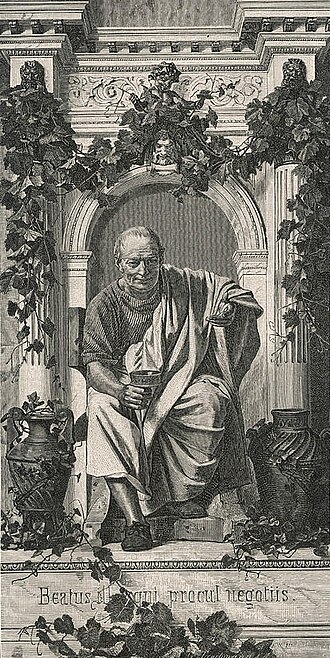
Fun Facts About Horace
- Horace fought for Brutus against Octavian at the Battle of Philippi, yet years later Octavian, by then the emperor Augustus, asked him to be his personal secretary. Horace refused.[1][3][4]
- Horace joked that at Philippi he fled without his shield, which let him identify with famous Greek poets who had abandoned their shields in battle.[1]
- Horace's father had been a slave for at least part of his life before gaining his freedom, and he spent a small fortune on his son's education.[1]
- Horace's day job was a civil service post at Rome's Treasury, an undemanding position as scriba quaestorius. It was about then that he began writing his Satires.[1]
- The poet of carpe diem built a pun on his own name: the sentiment inspired his repeated wordplay on Horatius and hora.[1]
- Horace's motto "Dulce et decorum est pro patria mori" lost its shine for poets like Wilfred Owen, for whom, after World War I, his poetry stood for discredited values.[1]
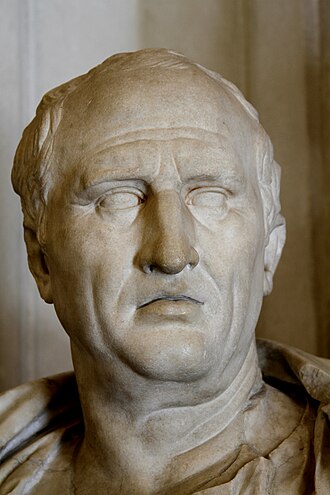
- Horace was alive at the same time as Cicero — their lives overlapped for 22 years (65 BCE–43 BCE).[1][2][5][6]
- Horace lived to about 57, from 65 BCE until 8 BCE.[1][2]
Quintus Horatius Flaccus, commonly known in the English-speaking world as Horace, was the leading Roman lyric poet during the time of Augustus. The rhetorician Quintilian regarded his Odes as the only Latin lyrics worth reading: "He can be lofty sometimes, yet he is also full of charm and grace, versatile in his figures, and felicitously daring in his choice of words."[1]
Read more on Wikipedia →Contemporaries
Questions About Horace
When was Horace born?
Horace was born in 65 BCE and died in 8 BCE.
How old was Horace at death?
Horace died in 8 BCE at about 57 years old (65 BCE–8 BCE).
What was Horace known for?
Horace was known for: Roman lyric poet of carpe diem. Quintus Horatius Flaccus, commonly known in the English-speaking world as Horace, was the leading Roman lyric poet during the time of Augustus. The rhetorician Quintilian regarded his Odes as the only Latin lyrics worth reading: "He can be lofty sometimes, yet he is also full of charm and grace, versatile in his figures, and felicitously daring in his choice of words."
Who was alive at the same time as Horace?
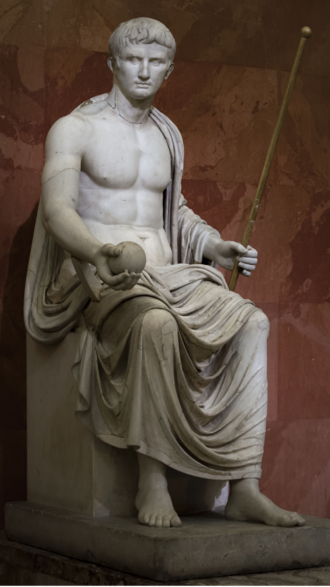
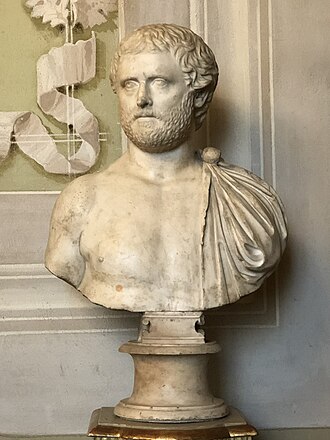
Horace's closest contemporary was Augustus. Their lives overlapped for 55 years.
Sources
- Horace — Wikipedia. Text available under CC BY-SA 4.0
- Horace (Q6197) — Wikidata
- Augustus — Wikipedia
- Augustus (Q1405) — Wikidata
- Cicero — Wikipedia
- Cicero (Q1541) — Wikidata
- Portrait: Quintus Horatius Flaccus.jpg — Wikimedia Commons. Anton von Werner, Public domain