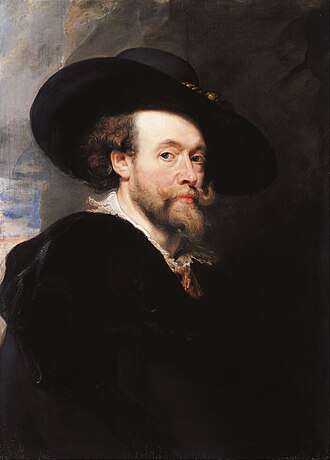
Fun Facts About Peter Paul Rubens
- Peter Paul Rubens was likely born in Siegen because his lawyer father had an affair with Anna of Saxony, wife of William I of Orange, and after prison was ordered to live there.[1]
- Rubens was also a diplomat who gathered intelligence on missions abroad. Philip IV of Spain raised him to the nobility in 1624, and Charles I of England knighted him in 1630.[1]
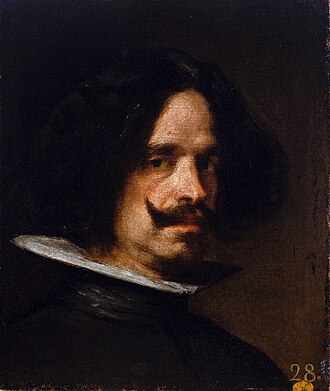
- In Madrid in 1628, Rubens befriended the court painter Diego Velázquez. The two planned to travel to Italy together, but Velázquez made the journey without him.[1][3][4]
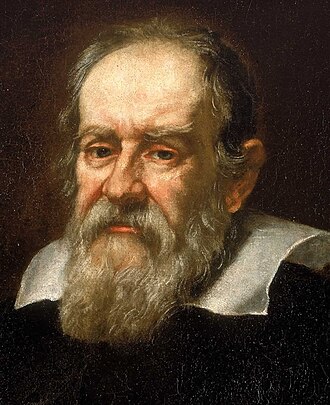
- Rubens counted Galileo Galilei among his friends and painted him as the central figure in a group portrait made in Mantua.[1][5][6]
- Rubens wrote letters in Italian, Dutch, French, Spanish and Latin, and signed his name as "Pietro Paolo Rubens", though his mother tongue remained the dialect of Brabant.[1]
- Many "Rubens" paintings were team efforts: he sometimes painted only the hands and faces, and handed animals, landscapes or still lifes to specialists like Frans Snyders.[1]
- Peter Paul Rubens was alive at the same time as John Locke — their lives overlapped for 8 years (1632–1640).[1][2][7][8]
- Peter Paul Rubens and Voltaire died on the same day of the year, May 30.[1][2][9][10]
Sir Peter Paul Rubens was a Flemish artist and diplomat. He is considered the most influential artist of the Flemish Baroque tradition. Rubens's highly charged compositions reference erudite aspects of classical and Christian history. His unique and immensely popular Baroque style emphasised movement, colour, and sensuality, which followed the immediate, dramatic artistic style promoted in the Counter-Reformation. Rubens was a painter producing altarpieces, portraits, landscapes, and history paintings of mythological and allegorical subjects. He was also a prolific designer of cartoons for the Flemish tapestry workshops and of frontispieces for the publishers in Antwerp.[1]
Read more on Wikipedia →Contemporaries
Their World
Questions About Peter Paul Rubens
When was Peter Paul Rubens born?
Peter Paul Rubens was born in 1577 and died on May 30, 1640.
How old was Peter Paul Rubens at death?
Peter Paul Rubens died in 1640 at about 63 years old (1577–1640).
What was Peter Paul Rubens known for?
Peter Paul Rubens was known for: Flemish Baroque painter. Sir Peter Paul Rubens was a Flemish artist and diplomat. He is considered the most influential artist of the Flemish Baroque tradition. Rubens's highly charged compositions reference erudite aspects of classical and Christian history. His unique and immensely popular Baroque style emphasised movement, colour, and sensuality, which followed the immediate, dramatic artistic style promoted in the Counter-Reformation. Rubens was a painter producing altarpieces, portraits, landscapes, and history paintings of mythological and allegorical subjects. He was also a prolific designer of cartoons for the Flemish tapestry workshops and of frontispieces for the publishers in Antwerp.
Who was alive at the same time as Peter Paul Rubens?
Peter Paul Rubens's closest contemporary was Galileo Galilei. Their lives overlapped for 63 years.
Sources
- Peter Paul Rubens — Wikipedia. Text available under CC BY-SA 4.0
- Peter Paul Rubens (Q5599) — Wikidata
- Diego Velázquez — Wikipedia
- Diego Velázquez (Q297) — Wikidata
- Galileo Galilei — Wikipedia
- Galileo Galilei (Q307) — Wikidata
- John Locke — Wikipedia
- John Locke (Q9353) — Wikidata
- Voltaire — Wikipedia
- Voltaire (Q9068) — Wikidata
- Portrait: Sir Peter Paul Rubens - Portrait of the Artist - Google Art Project.jpg — Wikimedia Commons. Peter Paul Rubens, Public domain